

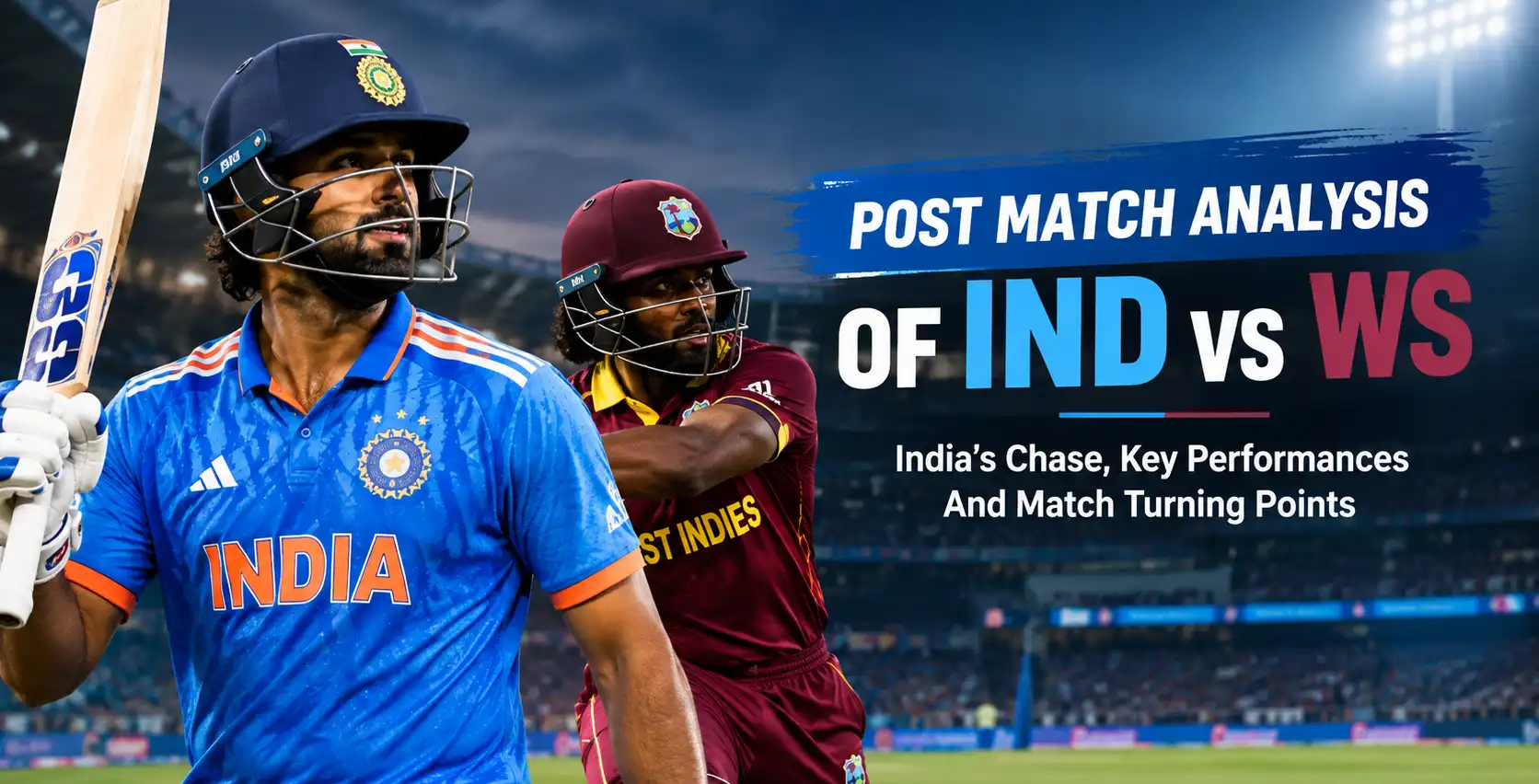
When you look at the post match analysis of IND vs WS the first thing that stands out is how India handled a target of 196 in a high-pressure T20 World Cup game. West Indies had put together 195/4 from their 20 overs and for a while the target looked like it could put India under pressure. Instead India chased it down with four balls left. The final score read 199/5 in 19.2 overs giving India a five-wicket win at Eden Gardens. Sanju Samson was the reason the chase stayed under control. He finished unbeaten on 97 from 50 balls, including 12 fours and four sixes. Was named Player of the Match. That makes the post match analysis of IND vs WS interesting because this was not simply a case of one team dominating from the over. West Indies had moments with the bat India lost wickets during the chase and the game was only settled in the over.
Match Summary: IND Vs West Indies
India won the toss and chose to field first at Eden Gardens. West Indies made 195/4 in 20 overs. Roston Chase gave the innings momentum with 40 from 25 balls, while Shai Hope scored 32 from 33. Shimron Hetmyer then added 27 from 12 balls.
The biggest late push came from Rovman Powell and Jason Holder. Powell stayed unbeaten on 34 from 19 balls, while Holder finished with 37 not out from 22 balls. Their late partnership helped West Indies reach a strong total.
India’s response was built around Samson. India reached 199/5 in 19.2 overs, winning with four deliveries remaining. Tilak Varma added 27 from 15 balls, while Suryakumar Yadav made 18 and Hardik Pandya scored 17.
West Indies Batting: A Strong Finish After A Mid-Innings Dip
The post match analysis of IND vs WS would be incomplete without looking at how West Indies reached 195. The opening phase was useful for West Indies, with Shai Hope and Roston Chase putting together a 68-run opening stand. Chase played the aggressive role, scoring at a strike rate of 160. Hope’s 32 came from 33 balls, so his innings was slower compared with the rest of the batting effort.
Once he was dismissed, Hetmyer immediately changed the tempo with 27 from 12 balls. West Indies were reduced to 119/4 in the 15th over, which meant the final six overs were going to be crucial.
Powell and Holder responded with an attacking finish. Holder’s 37 off 22 included three sixes, while Powell hit two sixes and three fours. That late hitting added the runs West Indies needed to push the score close to 200.
For India, Jasprit Bumrah was the leading wicket-taker with 2/36 from four overs. Varun Chakravarthy and Hardik Pandya also picked up wickets.
India’s Chase: Samson Took Control
The biggest talking point in this post match analysis of IND vs WS is obviously Sanju Samson. India lost Abhishek Sharma for 10 and Ishan Kishan for 10 early. That meant Samson had to spend time at the crease while also keeping the required scoring rate moving.
Suryakumar Yadav’s 18 from 16 balls helped India settle after the wickets. The pair added 58 runs for the third wicket before Suryakumar departed.
Tilak Varma then joined Samson and played exactly the kind of short innings India needed. His 27 came from 15 balls, including four fours and a six. That partnership reduced some of the pressure on Samson.
Samson, meanwhile, kept finding boundaries without throwing his wicket away. His 97 not out from 50 balls came at a strike rate of 194. He hit 12 fours and four sixes. ICC reported that the innings was the highest score by an Indian batter in a successful T20 World Cup run chase.
Read More: https://fantasy11.fun/top-end-t20-match-prediction/
The Turning Point Of The Match
The key turning point was probably India’s ability to recover from the wickets without allowing the required rate to get out of control. At one stage, India had lost two wickets for 41 runs. That gave the West Indies an opening.
Samson stayed there. That matters in a T20 chase because losing another wicket while the required rate is rising can quickly change the match. Instead, India kept scoring through Samson and got useful contributions from Suryakumar, Tilak and Hardik.
By the closing stages, India had enough control to finish the chase in the final over. The last over produced the boundaries needed, with Samson remaining unbeaten on 97 rather than reaching his century.
Bowling And Fielding: What West Indies Could Have Done Better
West Indies did manage five wickets, with Jason Holder and Shamar Joseph taking two each. Holder finished with 2/38 from four overs, while Joseph returned 2/42.
The problem was that Samson remained at the crease. Once a batter gets comfortable on an Eden Gardens surface, defending a high total becomes harder. West Indies created some pressure by taking wickets, but they could not produce the dismissal that would have opened the chase completely.
Their late bowling also allowed India to keep the scoring rate moving. That is a part of the post match analysis of IND vs WS: West Indies had moments where they were in the contest, but India managed those moments better.
What India Can Take From The Match
For India, the biggest positive was the ability to chase a target in a pressure game. The team did not rely on one opening partnership. Instead, Samson carried the chase while other batters contributed around him.
The bowling side also recovered after West Indies appeared set for a big finish. Bumrah’s two wickets helped prevent the total from going much higher, while India’s attack kept the West Indies total to 195/4.
The win also secured India’s place in the T20 World Cup semi-finals. ICC reported that India would next face England in Mumbai.
Player Performances That Shaped The Game
| Player | Performance |
| Sanju Samson | 97* off 50 balls |
| Tilak Varma | 27 off 15 balls |
| Roston Chase | 40 off 25 balls |
| Jason Holder | 37* off 22 balls and 2/38 |
| Rovman Powell | 34* off 19 balls |
| Jasprit Bumrah | 2/36 from 4 overs |
The numbers tell a clear story. West Indies had useful batting contributions, but Samson’s innings was the difference between a close chase and a successful one. The scorecard records also confirm that he was named Player of the Match.
Final Takeaway From The Post Match Analysis Of IND Vs WS
The post match analysis of IND vs WS comes down to pressure handling. West Indies recovered after losing wickets in the middle overs and finished with 195/4. That was a competitive total. India, however, did not panic after losing wickets.
Samson played the key role, scoring 97 without being dismissed. Tilak Varma and the middle order gave him support, while the Indian bowlers had earlier kept West Indies from reaching an even bigger total.
India eventually reached 199/5 in 19.2 overs and won by five wickets. For anyone searching for the post match analysis of IND vs WS, this game is an example of how T20 matches can change quickly. A strong total can still be chased when one batter controls the innings and the players around him contribute at the right moments.
FAQs About Post Match Analysis Of IND Vs WS
How did India chase 196 against the West Indies?
India kept the chase going after losing wickets early. Sanju Samson stayed at the crease. Scored 97 and not out. Tilak Varma, Suryakumar Yadav and Hardik Pandya all chipped in with runs around him. They didn’t let the momentum slip.
What made Sanju Samson’s innings so important?
Samson stayed unbeaten this time. He kept hitting boundaries. Didn’t take big risks. His 97 from 50 balls gave India the stability they needed. The run rate stayed under control, which made the chase feel possible.
Did West Indies put India under pressure during the chase?
Yes they took five wickets and had a real chance to pile on the pressure.. Samson’s long stay at the crease and the support from the middle order kept India ahead of the required rate. They never felt out of the game.
Which part of the West Indies innings made the difference?
The late partnership between Rovman Powell and Jason Holder was key. They batted aggressively. Helped West Indies post 195/4. That was a finish after the middle overs had seen wickets fall.
Why was 195 not enough for the West Indies?
195 was a total but India had Sanju Samson who controlled the chase. The middle-order batters also contributed. The burden wasn’t on one player alone. That made the target feel reachable.
How did India’s bowlers restrict West Indies?
India took wickets at moments. They stopped the West Indies from building a total. Jasprit Bumrah finished with two wickets for 36 runs in his four overs. That helped keep the run rate in check.
What was the main lesson from the match?
The match showed how important it is to have one batter stay at the crease during a T20 chase. Even when India lost wickets they kept scoring because Samson remained not out and others supported him.
Why is this match worth discussing after the result?
The game had shifted in momentum. West Indies batted well. Recovered. India lost wickets. The chase stayed close until the end. India only sealed it in the over. That’s why it’s worth talking about.